I just said no to UC Berkeley
On choosing the right mentor over the right name, and turning down a decade-long dream for a PhD at the University of Waterloo.
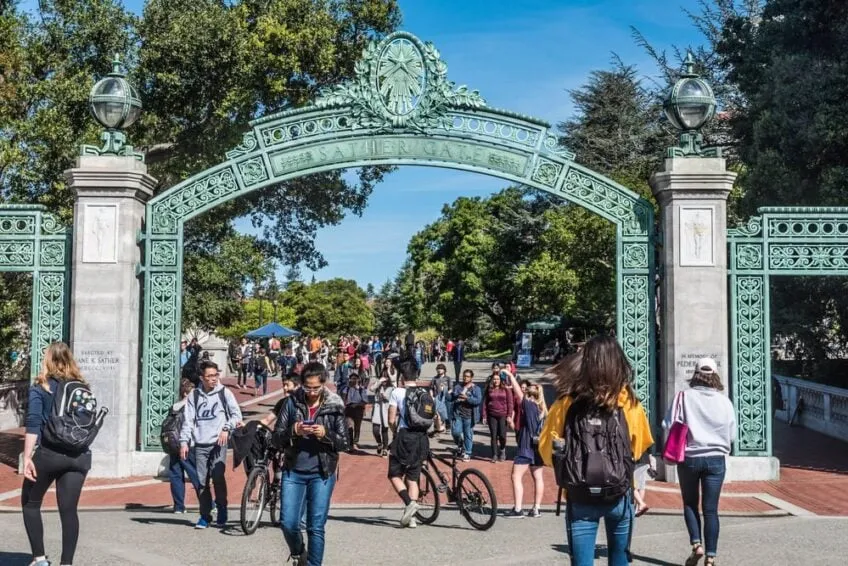
I just said no to UC Berkeley.
What am I doing?!
I moved to San Francisco from Miami, Florida almost 20 years ago with the intention of going to Berkeley one day. I was enthralled with its beautiful and historic campus, its rich history as a lefty anti-capitalist institution, and its location — close proximity to the gayest city on Earth. Because I couldn’t afford it at the time, my plan was to gain California residency first, then apply as an in-state student later, saving myself thousands in tuition.
But after visiting the campus, I realized my picture of the place was a little out of date. So I went to Mills College and got a degree in English Lit instead.
Last year, almost 20 years after first stepping foot on campus, I finally did apply to UC Berkeley, for a PhD in Vision Science.
I’ve spent the last four years as a contractor at Google working with the Vision Science team in the XR department. I’ve learned everything I know about eyeballs and Augmented Reality on the job, and I’ve loved most of every second of it.
But contractor roles come with a ceiling, and I could feel mine. I wanted to keep growing as a scientist, not stay boxed into an increasingly narrow scope.
So I had to figure out how to leave Google.
Because it was an obnoxiously bad decision to leave a decent paying tech job during a global recession simply because my ambition had outgrown my scope, I had to make it worth it. A PhD, after a while, seemed to me the way up and out.
My original plan was to only apply to Cal. The vision science program there is the best in the world, I knew 2-3 alumni from the program who would write me letters of recommendation, and I would get to stay in the Bay while I went to school. Win-win-win.
But then I met Austin Roorda.
He was the PhD mentor for one of my coworkers, and he was working on really cool tech. Naturally, I reached out to him for a chat before putting in my application. At this point in my career, I’ve learned to make a connection first before putting in an application second. Cal may have the name, but it means shite without the right mentor.
And Austin was that mentor. He’s a brilliant scientist with a wry sense of humor and a down to earth approachability. We got along really well, on our first meeting. I knew I could work with him and that he’d let me be creative.
But he also came with a wrench that he threw straight into my best laid plans: he was moving back to Canada.
Austin’s alma mater is the University of Waterloo, a well-known school for software engineering and quantum computing that’s about an hour and a half outside of Toronto, that I had never heard of. And he told me, upfront in our first video chat: if I wanted to work with him, I’d have to go to Waterloo.
Waterloo. Waaaaterlooo. A song by ABBA that would get stuck in my head repeatedly over the next 6 months as I contemplated moving to Siberia for my PhD.
“Am I a monk for science? Am I that guy?” I thought, over and over, while swimming in the Yuba River in September in sweltering heat, while visiting Disneyland in October in 80 degree weather, while staring out my window at the mild rain we call winter in San Francisco in December.
And despite my uncertainty with ever, truly, wanting to leave the Bay, I went through the motions. I knew I had met someone that would be a great mentor. I put in my application to University of Waterloo alongside my application to Berkeley. I wrote essays about how excited I was to learn how to build the newest AOSLO at Waterloo alongside essays about my background, experiences, and thirst for science for Cal.
And when Cal put me on the waitlist, I knew what I needed to do. It was PhD or no PhD, and my days at Google were numbered.
I worked with Austin to make the Waterloo offer more attractive — we worked together to figure out funding, I checked out the apartment buildings in Kitchener, I dreamed of a life very different but also very elevated from what I live now.
I’d finish faster. I wouldn’t have to do a year of coursework and lab rotations before finally getting down to the research. I’d have a mentor who believes in me and supports my ideas and best of all — wants me to be there. I’d have my partner who’d grown up in snow and two cats who would sleep on my lap when it gets too cold.
I had it all mapped out in my head, crystal clear, like a snow globe dream.
And then Berkeley called.
Berkeley took me off the waitlist on April 16th, one day after the decision deadline. I was absolutely shocked when I got the call. I had spent months working on the PhD offer at Waterloo. I had secured adequate funding, I had found an apartment building I liked, I had prepared myself mentally to leave the Bay Area. I had started packing up my apartment. And now it was all crashing down around me in a single possibility — the possibility of not having to leave.
It was too good to be true and too awful to be true. Could I really choose Berkeley after spending so much time planning and scheming with Austin?
I had to find out. I visited the campus again. I hung out at some labs, met with students, checked out the current projects. But it just didn’t feel right. I’d already spent a lot of time and energy on the Canadian path, and that’s where my heart was. My partner and I would be closer to family, I’d have a great mentor, and I was looking forward to the change in seasons. Plus, things didn’t look so hot in the US.
Of course. Of course I couldn’t go to Cal. I hadn’t made the same connection with anyone there that I had with Austin, and I’d also be choosing more uncertainty when I had a sure thing on the table. And so I finally turned a corner on a dream I had held for over a decade. The name Berkeley will always carry weight, but there are some things that are more important than institutional gravitas.
It was a tough choice, an agonizing choice, one that I spent months fretting over and years dreaming I’d have the chance to make. I had been offered admission to UC Berkeley, and in the end, that was enough. It didn’t matter whether I attended or not, whether I got my PhD wearing black and blue or red and green, whether I spend 4 years or 6 years completing the degree. I had been offered admission. I was good enough. And I could say no.